|
|
|
|
|
|
|
Mobile Walls as Flood Protection Systems
1. System Description
General
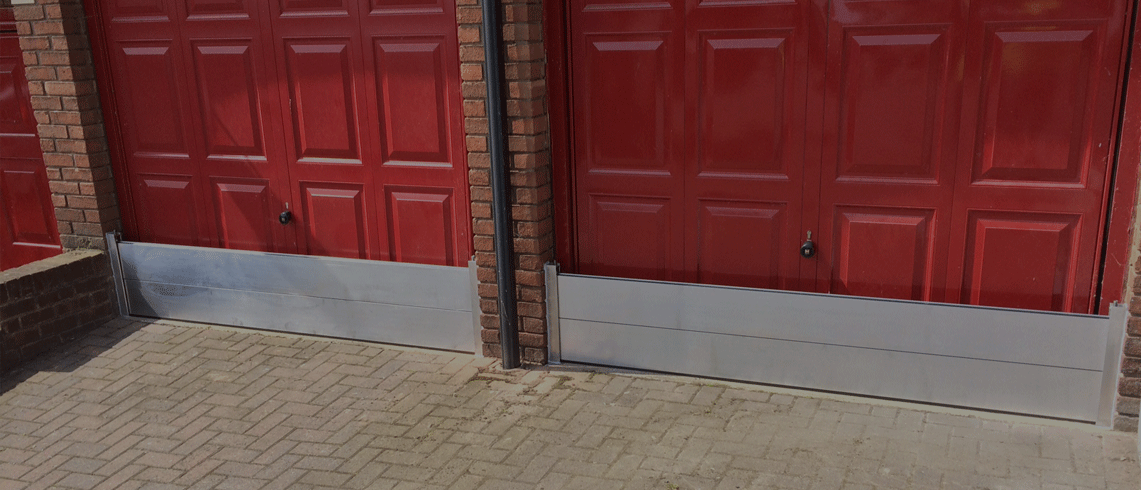
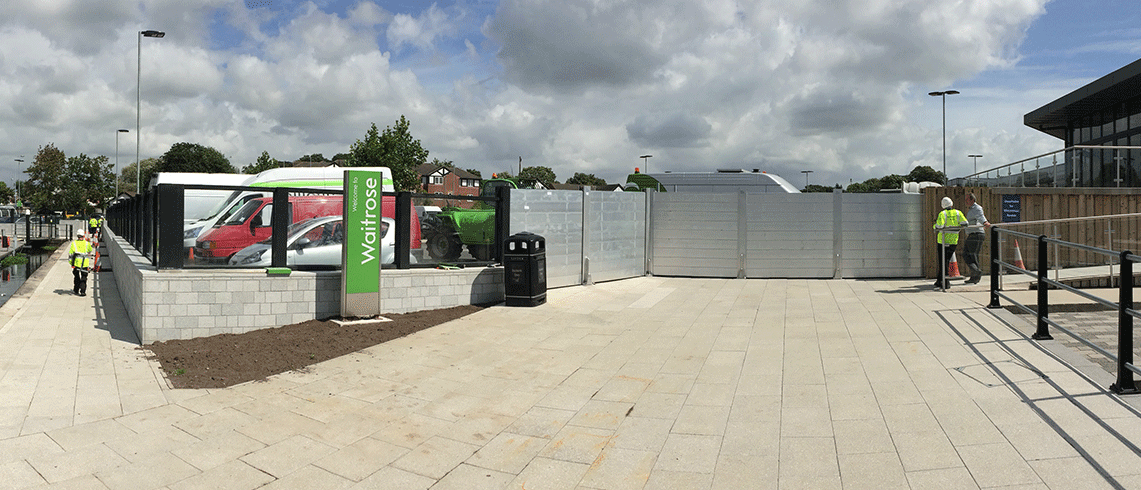
A mobile protection system enables the elevation of
flood protection systems while leaving the townscape, the sight and the traffic
conditions to and across the river largely unchanged. It therefore preserves
the identity and appeal of the city as well as the attractiveness and quality
of life of the real estate properties close to the river. In order to achieve
this added flood protection while leaving the everyday situation largely
unchanged under observation of today's safety standards, the construction and
operation of a mobile flood protection system has to meet the highest demands.
The principle of mobile flood protection walls made of dam beam systems
In principle, the mobile elements of the IBS systems
consist of two components. The center support posts, which are mounted at
regular distances in case of a flood, and the dam beams that are stacked
between the center support posts.
Two additional components are required for activating
the protection function: screw fittings and pressing tools. The
centre support posts are screwed together with the stationary reinforced
concrete construction via tapped bushes. In order to activate the system's high
degree of impermeability, the dam beams must be pressed in vertical direction
with the pressing tools. This seals the dam beams and ensures that the bottom
dam beam is clamped on the installation surface. This system consisting of
centre support post, dam beams, screws and pressing tools enables the
construction of mobile walls with a height in excess of 4.0 m with just 4
system components.
Flexibility
Radiuses larger than 20 m (with a support post
distance of 2.0 m) or larger than 30 m (with a support post distance of 3.0 m)
can be formed with standard support posts.
Angle supports are used for hinge points.
Inclines of up to 5% with surface unevenness of up to 15 mm
can be compensated. Height protrusions (steps) are overcome with flood height
transitions. Depending on the post interspaces, it is possible to construct
free-standing support post constructions in excess of 2.0 m. Rear support posts
are used in case of larger stress on the construction.
Materials
- Dam
beams made of aluminium extruded sections (AlMgSi)
- Support
posts as full-aluminium constructions (AlMgSi) or combinations of
aluminium extruded sections (AlMgSi) with hot-galvanised steel foot (S235)
- End
profile made of aluminium extruded sections (AlMgSi)
- Pressing
tools made of Gk-AlSi12 / V2a (W-no. 1.4301)
- Anchor
plates made of stainless steel (V2A, 1.4301 / V4a, 1.4571) with black
steel anchoring
- Seals
made of EPDM, PE / PUR
Due to the applied high-quality materials, which have been used
in flood protection for many years, we guarantee long durability
under proper storage conditions. The system is designed in such a way that
planned replacement purchases are not required during the material service
life.
Assembly ans Disassembly Times
The time period required for the assambly of the mobile
flood protection system consists of:
- the
alarm time - The time from the issue of the alarm and the readiness of the
assembly personnel
- the
loading time - Time for loading the transport vehicles
- the
transport time - driving time from the storage location to the deployment
location
- the
securing time / unloading time – time to secure the traffic along the
flood defence route, unload the vehicles and distribute the storage and
transport containers along the defence line
- assambly time – the time for preparing the
defence line, placing and screwing down the support posts and
inserting/bracing the dam beams
Only the setup time is significantly influenced by the
system. However, the local situation, e.g. the area behind the defence line,
the placement of support posts level to the ground or on embankments, etc, also
have an influence on the assambly time. The construction of a 100 m long, straight
mobile flood protection wall with a support distance of 3.0 m and a
protection height of 1.20 m requires 1
to 2 hours and 4 to 8 instructed workers on average with a
high-quality system configuration. Twice the time has to be calculated for disassambly, removal to the storage containers and cleaning.
Required Tools, Lifting Equipment and Transport Vehicles
The mobile elements (e.g. dam beams, support rods) are
stored in transport containers with a maximum weight of approx. 850 kg each.
Any lifting equipment
(e.g. tractor, fork lift, front loader, etc.) with transport fork or any type
of crane (slewing pillar crane, hall crane, truck crane, etc.) are suited for
this purpose. All vehicles/trailers
with a loading area of at least 2m x 3m can be used for transport.
The assembly of the system only requires simple tools (ratchet wrench with the corresponding hexagon
sockets).
2. System Variants
The following product types are available:
- IBS BSH-I 50 with
50 mm wide and 166 mm or 300 mm high dam beams for application of walls
with a maximum height of 1.50 m
- IBS BSH-I 100 light with 100 mm wide and 150 mm high dam beams for application of
walls with a maximum height of 3.0m
- IBS BSH-I 100 (heavy duty) with 100 mm wide and 150 mm
or 250 mm high dam beams for application of walls with a maximum height of
5.0m
- IBS BSH-I 100 (Köln) (heavy duty) with 100 mm
wide and 150 mm or 250 mm high dam beams for application of walls with a
maximum height of 5.0m
These product types provide technical variation
options that allow custom-tailored
solutions for just about any project situation.
3. Storage
We provide an advanced storage technology for our system. This technology
allows the contact-free storage of the dam beams and support posts. The system
is stored in hot-galvanised steel palettes equipped with fork tracks, crane
stop positions, stackable palette feet and tension belts. Due to the
contact-free storage of the individual parts on the steel palettes, these can
be simply rinsed off with a water hose after use.
|
|